

Building on the release of the 2026 American Dream Snapshot, I want to share the findings of the survey section by section. Highlighting the most important findings from our yearly survey with some of my commentary. This is the first in a series of posts I will release in the next few weeks.
First, the motivation behind this yearly survey is to push back against the pessimism and nihilism about the American Dream that we have seen in public debates and in the media over the last few years. The current Zeitgeist around the American Dream is that it is dead at worst, or at best taken for granted and misunderstood. It has become fashionable to criticize it, declare it dead based on misleading surveys, and focus only on pessimistic narratives pushed by politicians, media, and writers. If we continue down this path, we risk making the Dream’s demise a self-fulfilling prophecy. The American Dream is a unique cultural and national ethos across the world that needs to be cherished, rekindled, and can serve as an inspirational and unifying national vision for the United States for the next 250 years.
So, over the last seven years of our survey, we have asked people directly about their own lives and their families, without those mediating and pessimistic actors. We focus on listening to what people themselves say about the American Dream.
The good news is that the American Dream continues to be alive and well in 2026 and remains resilient after 250 years. Two-thirds of Americans are positive, saying they have either achieved the American Dream or are on their way to achieving it, while only one-third say it is out of reach.
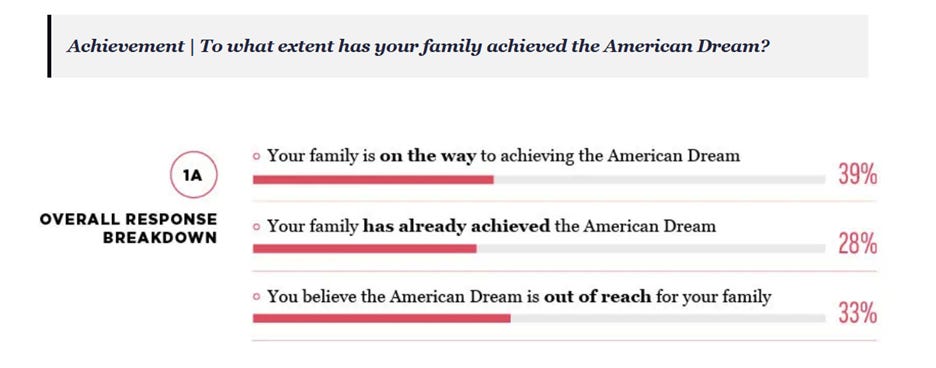
The bad news is that since last year, the mood around the American Dream has turned more negative. It is also more negative than it has been in recent years. Graph 1B shows our results since we first started conducting this survey in 2020. We have gone from 30% of people being pessimistic about the American Dream in 2025 to 33% this year saying that it is out of reach, up from a low of 18% in 2022. In 2024, this number was already at 32%, and in 2025 it came down to 30%, so I would not say the mood has soured simply because one political party or another is in office. Rather, it appears to be part of a broader trend.
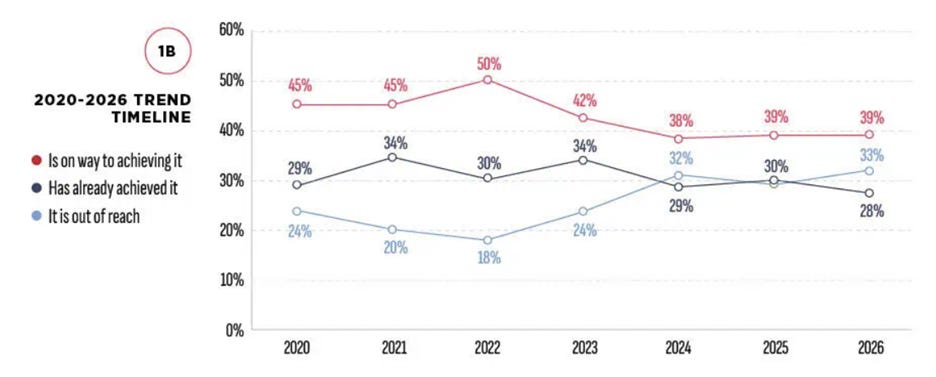
At least for 2026, given the state of the world and the uncertainties surrounding the wars in Europe and the Middle East, affordability concerns, the continuation of tariffs, and other political concerns such as the midterms, one could say it is remarkable that only 33% of respondents are pessimistic.
Looking at specific demographics in Table 1C, we can see that older people are more positive about the American Dream than younger people, which has also been the case in past editions of this survey.
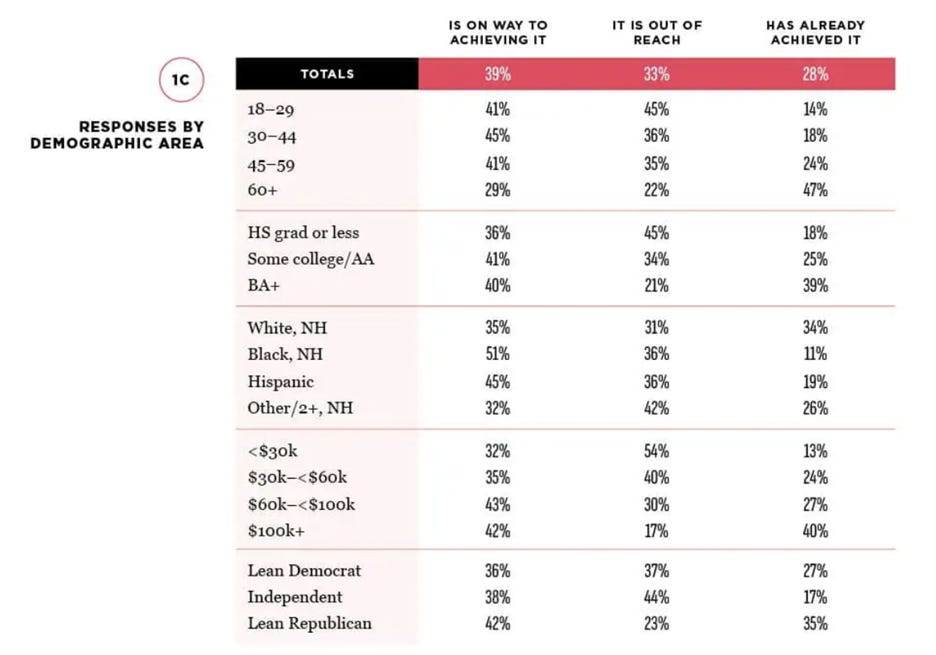
This could be because younger generations are more concerned about economic conditions, as we report in the next section, and because they may also be more anxious or nihilistic about the concept itself. One of my own hypotheses is that this could reflect the fact that they are still young and just starting out on their journey toward the American Dream. Many people, regardless of age, might not yet have a clear idea of what they want their American Dream to be, and it often takes time for people to find their dream and, certainly, their meaning and purpose in life. But this may be especially true for younger people, since they have not had sufficient time to think about their American Dream or take meaningful action to pursue it. Those in their late 20s, 30s, and 40s are still more pessimistic than those in their 50s and older, but to a lesser degree than those in their early 20s, perhaps because they have already had some opportunity to begin pursuing their dreams. Lower-income groups are also more negative about the American Dream. This is not only because economic adversity creates constraints, but also because fewer resources provide less financial security and flexibility to pursue one’s dream.
There are some differences among racial groups, income levels, and political leanings, but the results continue to be mostly positive.
Why Do Some People Feel the American Dream Is Out of Reach?
We also want to know why people think the American Dream is out of reach. In 2026, we encountered some negative news, but also some very positive news, much like last year’s edition of the survey.
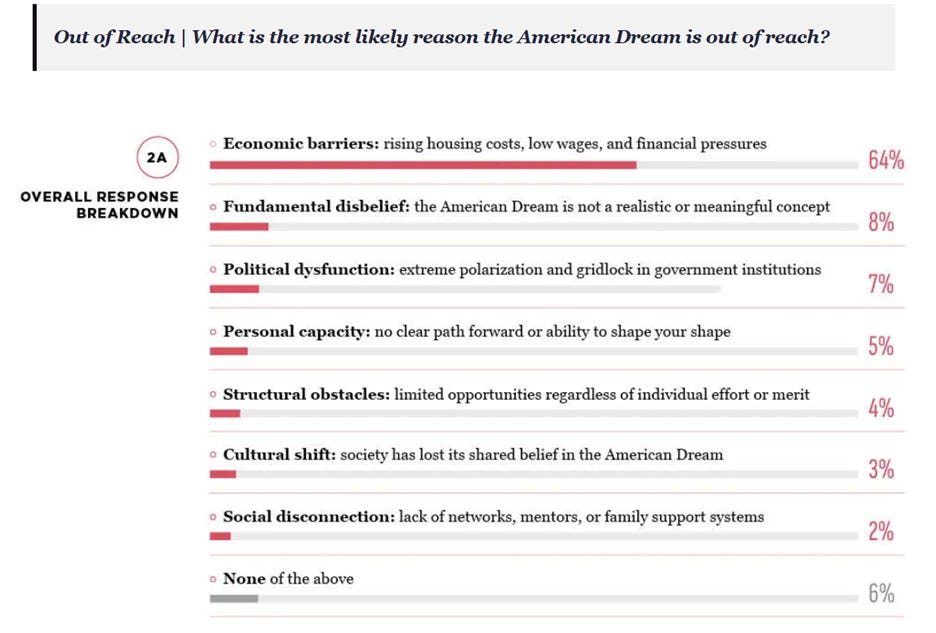
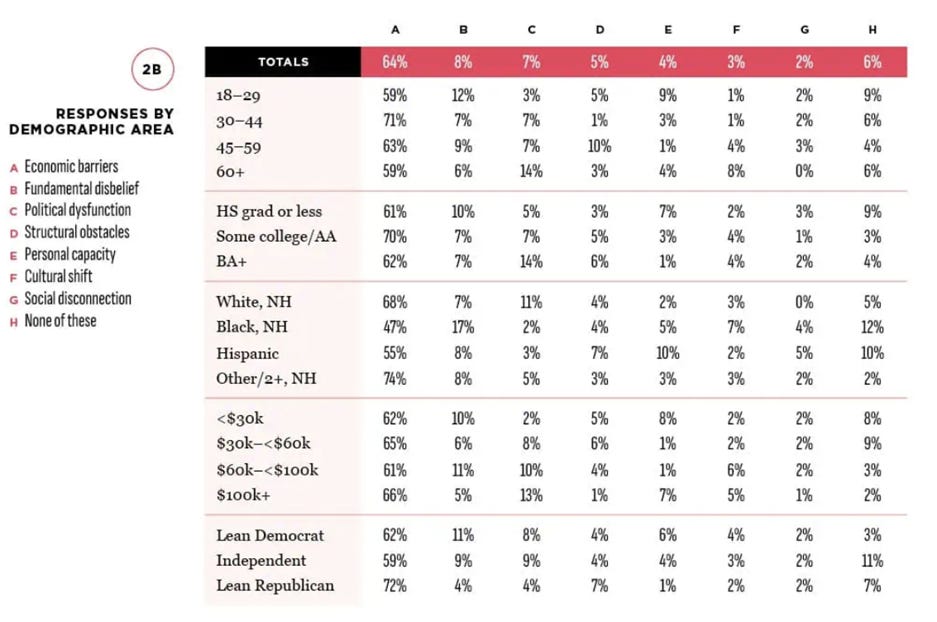
Starting with the bad news, most people, 64%, reported that the reason they are down on the American Dream and think it is out of reach is because of economic barriers such as rising housing prices, costs of living, low wages, and other financial factors. This response is larger than all other reasons combined. Given that lingering inflation concerns have not subsided since the pandemic, a war in the Middle East is raising oil prices, consumer sentiment surveys are at very low levels, and onerous zoning laws are making housing costs too high for many people to buy or rent, this response is not surprising. These are important challenges, and we need to address them.
However, the good news is that negative opinions are primarily driven by economic challenges. Why is this good news? Because economic challenges are complicated, but not necessarily complex. My mentor Arthur Brooks explains this distinction very succinctly here, and I’ve been trying to adapt it to the American Dream and our survey. For me, there are parts of the policymaking process that make economic barriers complicated issues to address. But they are complicated rather than complex because there is a clear cause-and-effect relationship within them; policy solutions can be evidence based and can be resolved through better decision-making. One could say that, because of public choice issues, the process of getting policy solutions passed may be more complex than complicated, since it includes many political and human relationship components as well as non-market decision-making. So these types of problems can overlap. But policy solutions can still be thought of as mostly complicated, not complex. By contrast, the other possible reasons for lack of faith in the American Dream are more related to complex issues, especially the fundamental disbelief response, which came in second at a low level of 8%. Why is this complex? Because a fundamental disbelief in the American Dream, and the belief that it was never a realistic or meaningful concept, would represent a significant cultural problem, a cultural shift, and a change in the broader narrative and views surrounding the American Dream. That kind of shift is more complex because many unpredictable variables contribute to such sentiments.
So, in that sense, the good news is that only 8% of respondents who do not think the American Dream is achievable, which is only about 3% of the total sample, hold that opinion because of a fundamental disbelief. Other complex issues, such as political dysfunction, personal capacity, and cultural shift, score even lower, which adds to that “good news” element. In total, we can say that only 30% of responses correspond to complex issues, amounting to about 9% of the total sample. That means we could say that 91% of people still believe in the American Dream in one way or another.
There are many challenges involved in reducing the economic barriers to achieving the American Dream. Addressing them is complicated and requires sustained effort from policymakers and the broader public policy community. But we can breathe a sigh of relief that the problem is not primarily a complex concern. We can continue believing that the cultural ethos of the American Dream has a real present possibility and a hopeful future.
This holds true for most of the demographic groups in our sample, apart from the youngest generation, Black respondents, and Democrats, who report more pessimism about the fundamental disbelief element while still being more concerned about economic barriers.
People Are on Their Way to Achieving the American Dream
The other good news from the survey comes from another follow-up question, which focused on the reasons people say they are on their way to achieving the American Dream. Here comes one of my favorite features of the American Dream, which many people misunderstand: the American Dream is mostly about the journey, not just the destination. Borrowing from what I wrote in our report, many people do end up achieving their American Dream, but what the Declaration of Independence calls the “pursuit of happiness” is certainly what the American Dream is all about: the pursuit of a better, richer, and fuller life, and whatever that means to each American.
At its essence, being on your way to achieving the American Dream first means that you have a dream, which is already an achievement in itself. Being willing to dream and developing meaning and purpose in life are not givens. The second requirement is to act on your human agency, your capacity to control your life and take action. In pursuing that American Dream, you must plan, act, assess progress, and persevere. Those are four key elements of the pursuit of the American Dream. In our survey, we asked people who are on their way to achieving the American Dream why they think they are on their way. Their answers are represented in Table 3A.
The responses are encouraging because they show the hopeful underpinnings of the American Dream. Hope is not a sufficient condition for achieving the American Dream, but it is certainly one of the most necessary preconditions for it. Pursuing one’s American Dream and being hopeful and optimistic about your chances does not mean that things will come easily. It does not mean there will be no challenges or suffering along the way. On the contrary, hard work, overcoming challenges, and perseverance are all intrinsic features of the American Dream, and in many cases, those features make the stories of achieving the American Dream even more meaningful. Through those inevitable challenges, having a hopeful mindset and narrative about your American Dream is key to success and to continuing to move toward your dream. Most of the responses in Table 3A show that hope.
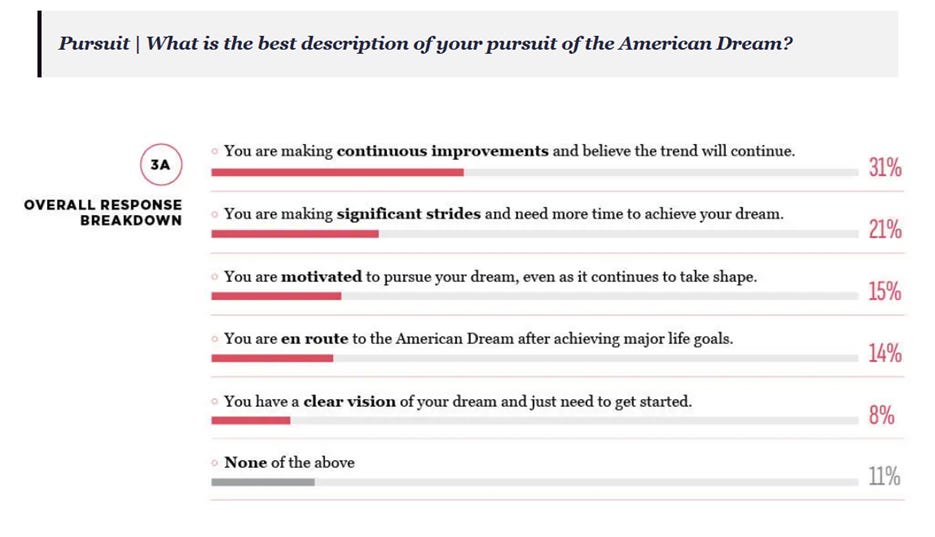
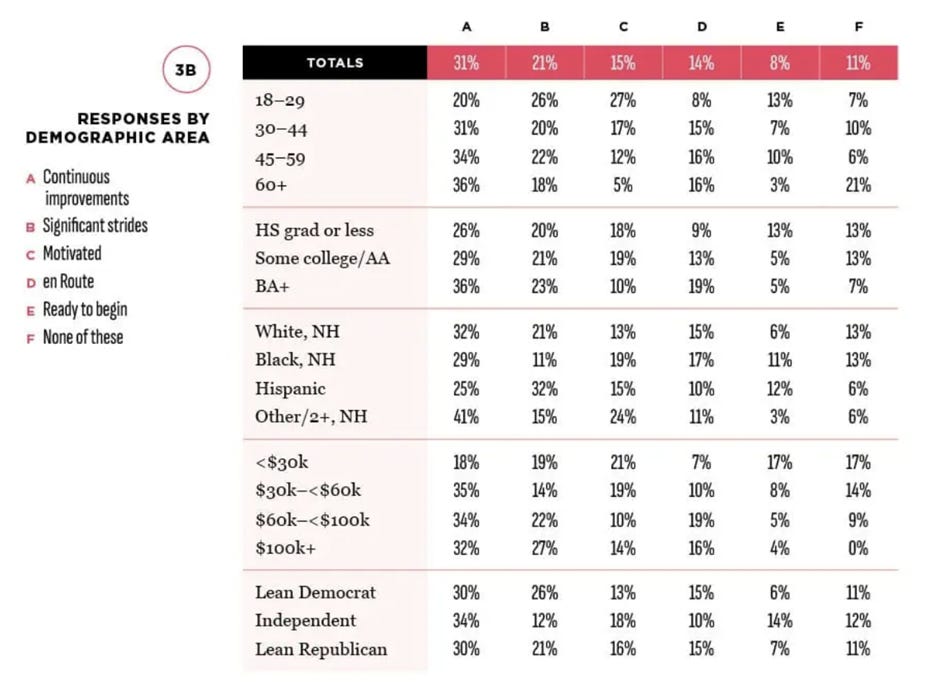
They show that people think they are on the right path, that they are motivated, that they have already achieved some of the goals that are part of their journey toward the bigger dream, and that they are moving forward and simply need more time. There is much to celebrate in these responses, since they all show that the journey toward the American Dream is alive and well. Table 3B shows that these responses cut across many demographic categories.
I’ll stop here and continue with the various other sections of the 2026 American Dream Snapshot in future installments of the series. But I do think it is important to stress the main finding of the core question in this report, which asks people directly what they think about their own chances of achieving the American Dream. The optimistic point I want to conclude with is that despite the current Zeitgeist around the American Dream and the challenges we face in removing barriers so that more people can achieve it, the American Dream continues to be alive and well and going strong after 250 years of the American experiment.